City Bike Racer: Traffic Rush
KingSpeed GameRacing
4.411.00 Reviews
- Version
- 1.0.4
- Installs
- 1.00M
- Age Rating
- Everyone
Screenshots
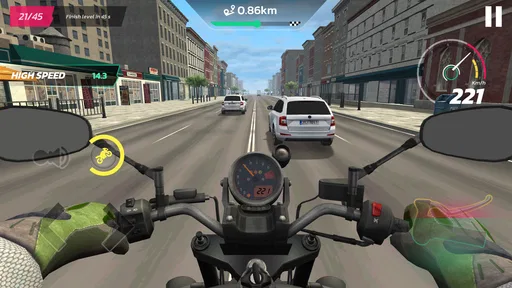
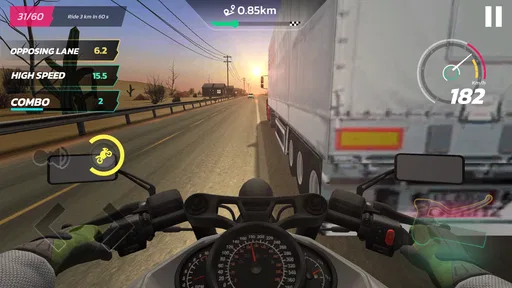
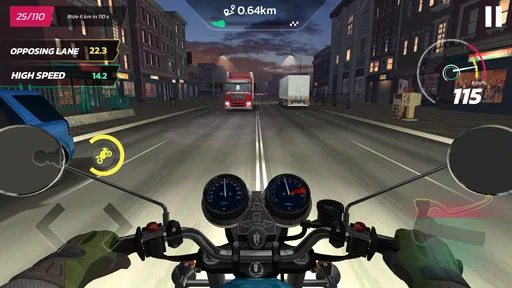
Our Review of City Bike Racer: Traffic Rush
 Analysis by Appyee
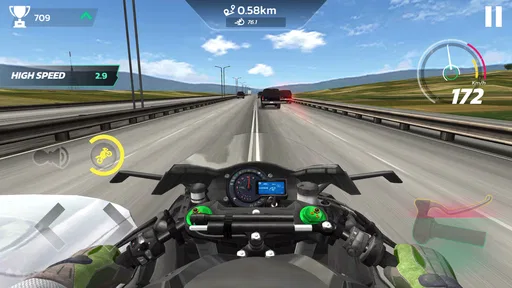
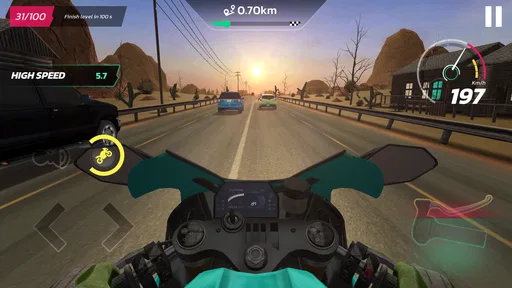
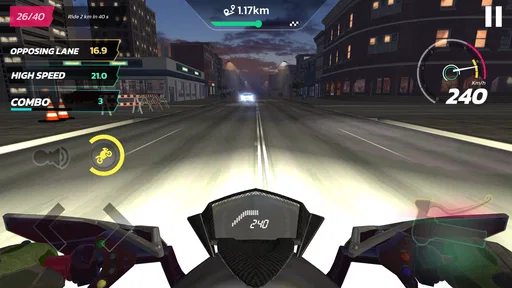
I spent time with City Bike Racer: Traffic Rush as a quick, pick-up-and-play racing game, and my first impression is that it aims for a very clear kind of fun: get on a motorbike, move through busy city streets, avoid trouble, and keep the ride going. It is not presented as a serious motorcycle simulator or a deep career game. Instead, it belongs to the lighter side of Android racing games, where the appeal comes from immediate control and short bursts of concentration.
That focus matters when deciding whether it deserves space on your phone. If I want a game I can open for a few minutes while waiting for an appointment, a straightforward traffic-racing format is attractive. If I am looking for a detailed garage, realistic handling, or a large competitive system, I would judge it by a different standard. City Bike Racer: Traffic Rush works best when I treat it as an accessible arcade ride rather than a full motorcycle package.
The game is free, carries an Everyone age rating, and comes from KingSpeed Game. Its store presence has reached over a million installs, while its average rating sits at 4.4 from around 1.3 thousand ratings. Those figures suggest that the concept is easy for a broad audience to understand, but they do not remove the need to consider how you personally play. A simple traffic racer can be enjoyable for casual sessions and still feel limited to someone who needs long-term progression.
What to judge before choosing a traffic racer
When I compare traffic racers, I first consider what kind of attention they ask for: quick reactions, route planning, or careful vehicle control. That distinction helps me decide whether a short road challenge will complement my usual games or merely duplicate them. Next, I look at how this particular motorbike ride fits into those habits.
Start with the kind of session you actually want
I would begin with one practical question: do you want a game that gets moving quickly, or one that asks you to learn a broad system over time? City Bike Racer: Traffic Rush is most appealing to the first type of player. The central idea is readable without a tutorial-heavy explanation. You are riding through an urban environment, watching the road, and reacting before traffic turns a clean run into a crash.
That makes it suitable for short sessions, especially when you do not want to remember a complicated control layout. It also makes the game approachable for younger players and for anyone who normally avoids racing titles because they seem too technical. The Everyone rating reinforces that accessible positioning, although an age label should not be confused with a guarantee that every player will enjoy the same level of pressure.
My second decision criterion is tolerance for repetition. Traffic-racing games often build their tension from a familiar loop: accelerate, read gaps, dodge vehicles, and try to maintain control for longer. The pleasure comes from improving reactions and choosing safer lines through the road. If that loop feels satisfying to you, the simplicity becomes a strength. If you need new tracks, extensive objectives, or a constantly changing structure, you may notice the boundaries sooner.
Controls matter more than decoration here
For this type of game, I pay more attention to how quickly I can understand movement than to how many menu options are available. A city street filled with traffic gives the player very little time to hesitate. The useful skill is not simply pressing a button quickly; it is looking ahead, identifying the next opening, and avoiding a move that creates a second problem immediately afterward.
One tip I found valuable is to stop treating every gap as an invitation. The tempting opening is not always the safest route, particularly when another vehicle makes the road ahead harder to read. I get better results by planning one decision beyond the immediate obstacle. That small change turns the experience from random swerving into a basic rhythm of observation and commitment.
I also recommend using early attempts to learn the visual spacing of traffic rather than chasing a perfect run immediately. In a compact arcade game, a failed ride can still teach you where your attention breaks down. Do you react too late when vehicles enter from the side? Do you move repeatedly because you are uncertain? Identifying that habit is more useful than simply blaming the traffic pattern.
Version and device expectations
The current version is 1.0.4, and the listed minimum operating system is Android 7.0. That makes the game relevant to people using older Android phones, at least from a compatibility standpoint. I would still think about the practical condition of your handset: a device that technically meets a minimum requirement may not provide the same comfort as a newer phone with a responsive screen and stable performance.
For a traffic game, touch response is especially important. A slight delay can make a safe-looking gap feel unfair, while a small screen can make surrounding vehicles harder to read. I would play with the phone held securely and keep the display free from accidental touches. That sounds obvious, but it is a real part of the experience when success depends on quick, controlled movement rather than long strategic planning.
Where City Bike Racer: Traffic Rush earns its place
For me, City Bike Racer: Traffic Rush earns consideration when I want a focused break rather than a full racing session. Its appeal is less about building a collection and more about making each move count, so I would judge its staying power by whether I enjoy refining those decisions. That makes the next section’s question practical: what role can it fill week after week?
It communicates its appeal quickly
The strongest quality is clarity. I do not need to imagine a complicated storyline or study a long list of systems to understand why I might enjoy a ride. The city setting, motorbike focus, and traffic-dodging premise create an immediate objective. That is useful for a game intended to fill small pockets of free time.
Many mobile racing games try to cover too many activities at once. They may combine driving, customization, missions, upgrades, and social competition until the basic act of racing becomes buried under menus. City Bike Racer: Traffic Rush has a more direct identity. The road is the main event, and the player’s attention stays on movement and hazards.
That directness is also why I can recommend it to someone who wants a casual alternative to more demanding racing games. You do not have to approach it like a simulation enthusiast. The enjoyment comes from reacting to traffic and gradually becoming more confident with the road. It is an easy game to show to a friend because the objective can be explained in one sentence.
The traffic creates a useful risk-and-reward choice
The interesting decision is not merely whether to move left or right. It is deciding how much risk is worth taking. A wide, obvious route may be safer but less exciting, while a narrow opening can feel rewarding when judged correctly. I like that this gives the simple premise a little more thought than constant random movement.
A practical way to play is to divide the road into near, middle, and far attention zones. I use the near zone to avoid an immediate collision, the middle zone to choose my next direction, and the far zone to notice whether the route is closing. Even without turning the game into a technical exercise, this habit makes the ride calmer and reduces panic swerves.
Another useful trade-off is speed versus information. Moving aggressively can make the game feel more thrilling, but it also reduces the time available to read the next obstruction. When I am trying to improve, I prefer a controlled pace first. Once the traffic feels familiar, I take more ambitious lines. That approach is more reliable than playing every attempt at maximum intensity.
It fits everyday interruptions
Imagine waiting for a coffee order, sitting before a class begins, or taking a short break between errands. You may want something more engaging than scrolling but not something that demands a twenty-minute commitment or a complicated setup. This is where the game makes sense to me. I can approach a session with a narrow goal: settle into the road, make cleaner decisions, and stop when the break ends.
It also works for players who share a phone casually with family members. Because the premise is easy to explain and the content rating is Everyone, a younger player can understand the basic challenge without needing a long introduction. I would still supervise children according to my own judgment, particularly because racing pressure can encourage repeated attempts and extended play.
The free entry point lowers the decision risk
There is no purchase price to overcome, which makes trying the game straightforward. For me, that changes the standard slightly: I do not need it to replace every other racing game. It only needs to provide enough immediate entertainment to justify keeping it installed. A free game with a focused loop can be worthwhile if it serves that small role well.
Still, free does not automatically mean frictionless. I would decide based on how comfortable I am with the game’s overall presentation and how often I want to return. The important point is that I can test the central riding experience without first committing money to a large racing package.
Where another racing category may suit you better
I would look elsewhere if my favorite part of racing is mastering a circuit, tuning a vehicle, or exploring a large environment. Those alternatives offer different kinds of satisfaction, not simply more of the same, and choosing one can prevent a mismatch between expectation and play. The trade-offs become clearer when I consider what changing games would actually involve.
Choose a simulation-style game for realism
If your priority is authentic motorcycle behavior, detailed braking, cornering technique, and a strong sense of machine weight, this is probably not the direction I would choose. City Bike Racer: Traffic Rush is built around the readable excitement of navigating traffic, not around reproducing every part of real riding. A motorcycle simulation would be a better fit for someone who enjoys learning precise handling and accepting a steeper curve.
The difference is not simply difficulty. It is the kind of attention each game rewards. A simulation asks me to understand the vehicle. This game asks me to understand the road in front of me. Neither approach is automatically superior, but they satisfy different moods. I would not download this title expecting it to teach real-world riding skills or replace a realistic motorcycle experience.
Choose a track racer for structured competition
Traditional track racing is a stronger alternative when I want defined laps, recognizable corners, overtaking tactics, and a finish line that organizes the entire event. City traffic creates a more reactive challenge. The road is about finding openings and surviving changing obstacles, while a track racer usually gives me a clearer route to study and optimize.
That distinction helps explain why some players may enjoy both categories. I can use a traffic racer for quick reflex sessions and a track game when I want a longer contest with a more deliberate racing line. If your main goal is to compare lap times or master a circuit, choose the category designed around that structure rather than asking this game to provide it.
Choose an open-world game for exploration
Players who want to roam freely, discover locations, customize a rider, or build a sense of place may prefer an open-world driving or motorcycle game. The city setting here is functional: it gives the traffic challenge a recognizable environment. I would not approach it as a sightseeing experience or as a large virtual destination.
This is one of the clearest reasons to skip it. If exploration is the part of driving games that keeps you interested, a focused traffic loop may feel narrow after the initial novelty. On the other hand, that same narrowness is helpful when I want fewer distractions. The game does not need to compete with an open-world title on its own terms.
Consider the long-term progression you need
Before switching from a larger racing game, I would ask how much progression I expect. Some players need a substantial sense of growth: new vehicles, elaborate events, changing objectives, or a detailed collection to work toward. Others are satisfied by personal improvement, where the reward is a cleaner run and better judgment.
City Bike Racer: Traffic Rush is a better match for the second group. Its appeal depends on the road challenge remaining enjoyable even when the novelty of the premise has settled. If you lose interest quickly without a large progression structure, I would choose a more system-heavy racing game instead. That is not a flaw in the concept; it is a mismatch between the game’s compact identity and your preferred reason for playing.
The real cost of switching to it
Switching to a compact traffic challenge can simplify the moment-to-moment decision, but it also means accepting a narrower focus than many larger racing games. I would keep a current favorite available until I know whether this road-based loop suits my breaks and attention span. The useful test is not whether it replaces everything, but whether it earns a distinct place.
What you gain by replacing a heavier racer
Switching to this game can reduce mental overhead. I do not have to prepare for a long event or remember a complex set of upgrades before I can enjoy a ride. The main skill is available immediately: read the city traffic and make better movements. For a player who has become tired of menus, lengthy races, or complicated tuning, that simplicity can feel refreshing.
The other gain is flexibility. I can use it as a secondary racing game rather than a permanent replacement. Keep a detailed racer for serious sessions, then use this one when I want a faster reaction challenge. That arrangement makes more sense to me than forcing every game to satisfy every need.
What you give up
The trade-off is depth. A focused traffic game may not provide the same sense of ownership as a title built around garages, vehicle development, or a broad championship structure. It may also feel repetitive to players who need constant novelty. I would not call that a hidden defect; it is the cost of choosing immediacy over breadth.
You also give up some predictability compared with a fixed circuit. Traffic requires continuous adjustment, so a run can be shaped by what appears ahead rather than by a route you have memorized. Players who prefer carefully rehearsed corners may find that less satisfying. Players who enjoy adapting in real time may see it as the main attraction.
How to make the switch easier
I would not uninstall a favorite racing game immediately. First, use City Bike Racer: Traffic Rush in three different ways: one relaxed session to learn the road, one controlled session focused on avoiding unnecessary risks, and one more aggressive session to test your reactions. That gives you a fair sense of whether the loop has enough variety for your habits.
It also helps to decide what success means before playing. If you judge every attempt only by its final result, traffic games can become frustrating. Instead, watch for specific improvements: fewer panic movements, earlier recognition of blocked routes, or better decisions when two openings appear. Those small targets reveal whether the game’s core challenge is rewarding you.
For a phone shared with other people, I would also consider when you play. A short reaction game is convenient, but it can be awkward if you need to stop suddenly during a tense run. Treat it as a focused break, not as something to use while walking, crossing a street, or handling another task. The road may be virtual, but your real surroundings still deserve priority.
My recommendation for the right player
I would recommend it to someone who enjoys short, reactive motorbike sessions and does not need every race to unlock a larger career. Players who want realism, exploration, or extensive progression will likely be happier elsewhere. The final choice comes down to whether repeating a focused traffic challenge feels like a satisfying habit rather than a brief novelty.
Who should download it
I recommend City Bike Racer: Traffic Rush to players who want a free, uncomplicated motorcycle racing game centered on city traffic. It is a sensible choice for short sessions, casual racing fans, younger players within the Everyone rating, and anyone who enjoys improving through repeated attempts rather than collecting a large number of systems.
I especially like it as a companion game. If your main racing title feels too demanding for a quick break, this offers a more immediate alternative. The over-one-million-install audience and 4.4 average rating show that the basic idea has broad appeal, but my recommendation is still based on the fit between the game’s focused traffic challenge and the way you want to play.
Who should skip it
I would skip it if you are searching for a realistic motorcycle simulator, a deep career mode, a large open city to explore, or a structured track championship. I would also be cautious if repetition quickly bothers you. The game’s strength is its narrow focus, so that same focus becomes a weakness when you need extensive variety or a long-term collection goal.
It is also not the best choice if you want a game that teaches real riding technique. Avoiding digital traffic can sharpen game reactions, but it should never be treated as a substitute for safe motorcycle training or awareness on actual roads. That distinction is important, especially because the game’s theme can make the virtual activity feel more realistic than it is.
My final view after weighing the alternatives
KingSpeed Game has chosen a practical arcade formula: put the player on a motorbike, create a busy urban route, and make every movement a quick judgment. I find that formula effective when I want immediate action without a large learning burden. The free price and broad age rating make trying it easy, while the Android 7.0 minimum keeps it relevant to people with older compatible devices.
My honest recommendation is to download it if you want a compact traffic-dodging racer and are comfortable with a focused loop. Approach it as a game of observation, timing, and controlled risk, not as a complete motorcycle simulation. If you understand that trade-off, the best reason to keep playing is the satisfaction of making cleaner decisions on a crowded road.
In short, this is a good fit for quick arcade sessions and a weaker fit for players who measure racing games by realism, exploration, or extensive progression. I would give it a chance when I need a simple motorbike challenge, but I would choose a different category when I want a richer racing hobby. That clear role is what makes the game easy to recommend to the right friend rather than to everyone.
Verdict
Strengths of City Bike Racer: Traffic Rush
- Simple controls make it easy for beginners to start racing.
- Short sessions are ideal for quick gameplay breaks.
- Traffic dodging provides a satisfying test of timing and reflexes.
- Bike-focused gameplay feels lighter and more accessible than complex racers.
- Progression encourages repeated runs and gradual improvement.
Limitations of City Bike Racer: Traffic Rush
- Gameplay can become repetitive after extended play sessions.
- Difficulty may feel unforgiving when traffic patterns become crowded.
- Limited variety may reduce long-term appeal for experienced players.
- Frequent crashes can make some runs feel more frustrating than rewarding.
- Performance may vary on older devices during busy traffic scenes.
Similar Picks in This Category
View All
Hill Climb Racing
Fingersoft4.3

Dr. Driving
SUD Inc.4.2

Traffic Rider
skgames4.5

Asphalt 8 - Car Racing Game
Gameloft SE4.6

Race Master 3D: Car Racing
Beresnev Games4.6

Extreme Car Driving Simulator
AxesInMotion Racing4.3
Frequently Asked Questions
What is City Bike Racer: Traffic Rush?
City Bike Racer: Traffic Rush is an arcade-style motorcycle racing game focused on weaving through busy city traffic at high speed. During testing, the main appeal was its simple pick-up-and-play design: you control the bike, avoid cars, collect rewards, and try to travel as far as possible. It is aimed at casual players who enjoy quick races rather than a realistic motorcycle simulator.
How do you play City Bike Racer: Traffic Rush?
Gameplay is built around steering your motorcycle through lanes filled with moving traffic while avoiding collisions. Depending on the control option available on your device, you may use touch gestures, buttons, or tilt controls to change direction. The longer you survive, the more opportunities you have to earn points and improve your performance. Fast reactions are essential, especially when traffic becomes denser.
Can City Bike Racer: Traffic Rush be played offline?
The core racing experience can generally be enjoyed without a continuous internet connection, which makes the game suitable for short sessions while traveling or when mobile data is unavailable. However, some features may still require internet access, including advertisements, online services, updates, or optional rewards. It is best to launch the game once while connected before relying on it completely offline.
Is City Bike Racer: Traffic Rush free to download?
City Bike Racer: Traffic Rush is generally offered as a free download, allowing players to install and try the main gameplay without paying upfront. Like many free mobile games, it may include advertising and could offer optional in-app purchases, such as removing ads, unlocking content, or obtaining extra resources. Check the store listing on your specific Android or iOS device for current pricing details.
Is City Bike Racer: Traffic Rush suitable for children?
The game is relatively easy to understand because its main objective is simply to ride, avoid traffic, and achieve a higher score. Nevertheless, parents should review the age rating and store information before installation, since ratings can vary by region and platform. Advertising, in-app purchases, and the fast-paced nature of the gameplay are also worth considering when deciding whether it is appropriate for a child.
Play our best games!


